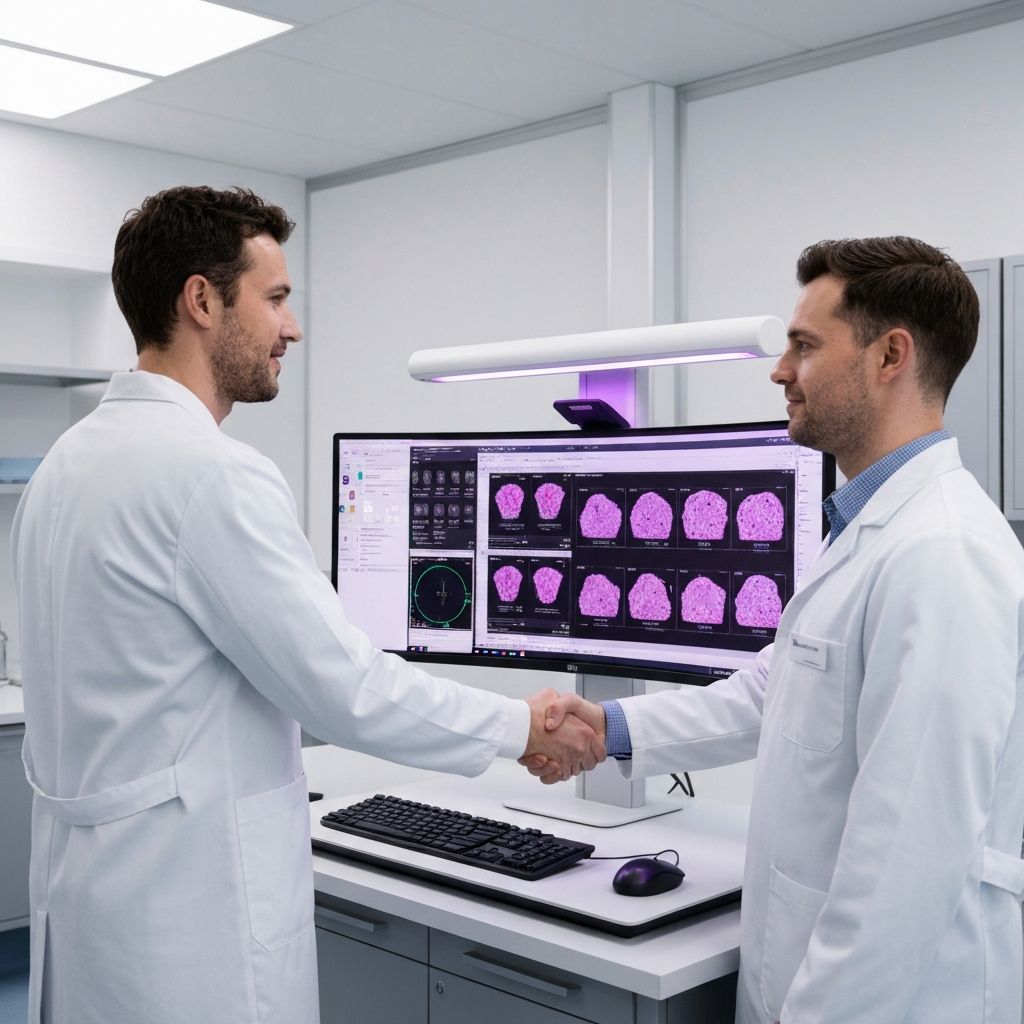
Our research team has published new work in Nature Digital Medicine on AI-assisted PD-L1 quantification. The paper covers five tumor types and compares automated scoring against a consensus of three expert pathologists on more than one thousand slides.
What we measured
PD-L1 scoring is notoriously subjective. Inter-observer agreement between expert pathologists routinely sits in the 0.6 to 0.75 kappa range, which means even specialists disagree on a meaningful fraction of cases. That variability matters: PD-L1 status drives immunotherapy eligibility for hundreds of thousands of patients every year.
We set out to measure three things. How close can an algorithm get to an expert consensus? How much does algorithm-assisted reading reduce disagreement between pathologists? And can the same model generalize across tumor types without retraining?
Headline results
- Agreement with expert consensus: kappa 0.89 across five tumor types.
- Inter-pathologist agreement rose from kappa 0.71 unassisted to 0.86 with AI concurrent read.
- The single model generalized to all five tumor types without fine-tuning.
The interesting finding is not that AI matches experts. It is that AI makes experts more consistent with each other.
What this enables
Consistency is the piece the biomarker field has been missing. If the same slide is scored reproducibly across sites and across readers, companion diagnostics become far more reliable, and clinical trial stratification becomes cleaner. This is the foundation we are now building on with our pharmaceutical research partners.